

Speaking English becomes easier and more fun when you know how to use idioms. Idioms help you share your thoughts, express feelings, and make everyday conversations sound more natural.
However, their meanings are not always clear from the words themselves. For example, break the ice does not mean breaking real ice. It means starting a friendly conversation.
In this guide, you will learn 31 useful idioms for speaking, along with their simple meanings and real-life examples.
These expressions can help you talk with friends, join group discussions, and feel more confident when speaking English in daily life.
Quick Answer?
Some useful idioms for speaking include break the ice (start a conversation), get straight to the point (speak about the main subject), speak your mind (share your honest thoughts), beat around the bush (avoid the main subject), and put in a good word (say something positive about someone). These idioms make everyday English conversations clearer, more natural, and more interesting.
What Are Speaking Idioms?
Speaking idioms are common English expressions that people use to communicate ideas, feelings, and opinions. Their meanings are often different from the literal meanings of their words. People use them in friendly chats, meetings, discussions, and other social situations. Learning these expressions helps you understand native English speakers and express yourself in a more natural way.
Quick Overview?
| No. | Idiom | Short Meaning | Suitable Context |
|---|---|---|---|
| 1 | Break the ice | Start a conversation | Social situations |
| 2 | Speak your mind | Share honest thoughts | Discussions |
| 3 | Get straight to the point | Talk about the main subject | Meetings |
| 4 | Beat around the bush | Avoid the main topic | Daily conversations |
| 5 | Have a word with someone | Talk to someone | Personal discussions |
| 6 | Put in a good word | Recommend someone | Work and school |
| 7 | Talk the talk | Speak confidently about something | Discussions |
| 8 | Walk the walk | Show actions match words | Everyday life |
| 9 | Get the message across | Make an idea understood | Communication |
| 10 | Keep someone in the loop | Keep someone informed | Work and school |
| 11 | Read between the lines | Understand hidden meaning | Conversations |
| 12 | Let the cat out of the bag | Reveal a secret | Friendly chats |
| 13 | Spill the beans | Tell secret information | Informal chats |
| 14 | Talk someone into something | Persuade someone | Daily life |
| 15 | Talk someone out of something | Persuade someone not to do something | Advice |
| 16 | A heart-to-heart | An honest personal talk | Close relationships |
| 17 | Small talk | Casual conversation | Social events |
| 18 | Make small talk | Start casual conversation | Meeting people |
| 19 | Speak volumes | Show a lot without words | Discussions |
| 20 | Have the last word | Finish an argument or discussion | Arguments |
| 21 | Bite your tongue | Stop yourself from speaking | Difficult situations |
| 22 | Hold your tongue | Remain silent | Arguments |
| 23 | On the tip of your tongue | Almost remember a word | Daily conversations |
| 24 | Get a word in edgewise | Find a chance to speak | Group discussions |
| 25 | Word of mouth | Information shared by people | Recommendations |
| 26 | Talk behind someone’s back | Speak negatively about someone secretly | Social situations |
| 27 | Give someone a piece of your mind | Express anger directly | Arguments |
| 28 | Talk shop | Discuss work-related topics | Professional settings |
| 29 | Put words in someone’s mouth | Misrepresent someone’s statement | Discussions |
| 30 | Actions speak louder than words | Actions matter more than promises | Advice |
| 31 | Easier said than done | Harder to do than to say | Everyday discussions |
31 Useful Idioms for Speaking
1. Break the Ice

Meaning: To start a conversation and make people feel comfortable with each other.
When to Use: Use this idiom when you meet new people or join a group where everyone feels shy or quiet.
Examples:
- Ali told a funny story to break the ice at the school party.
- Our teacher played a quick game to break the ice on the first day of class.
2. Speak Your Mind
Meaning: To express your honest thoughts and opinions without hiding them.
When to Use: Use it when someone is encouraged to share their real feelings or ideas. It is common in friendly discussions and personal conversations.
Examples:
- You should speak your mind during the class discussion.
- I always speak my mind when my friends ask for my opinion.
3. Get Straight to the Point
Meaning: To talk about the main subject without wasting time on unnecessary details.
When to Use: Use this expression in meetings, serious conversations, or situations where people need clear information quickly.
Examples:
- Please get straight to the point because we have little time.
- The manager got straight to the point during the meeting.
4. Beat Around the Bush
Meaning: To avoid talking directly about the main subject.
When to Use: Use this idiom when someone takes too long to explain something instead of saying what they really mean. It is informal.
Examples:
- Stop beating around the bush and tell me what happened.
- My friend kept beating around the bush when I asked about her mistake.
5. Have a Word With Someone
Meaning: To have a short conversation with someone about something.
When to Use: Use this expression when you want to talk privately or briefly with another person. It can be friendly or serious.
Examples:
- I need to have a word with my teacher after class.
- Can I have a word with you about tomorrow’s plan?
6. Put in a Good Word
Meaning: To say something positive about someone, often to help them get an opportunity.
When to Use: Use it when recommending a person for a job, position, or other opportunity.
Examples:
- My uncle put in a good word for me at his company.
- The teacher put in a good word for Sara because she works hard.
7. Talk the Talk
Meaning: To speak confidently or convincingly about something.
When to Use: Use this idiom when someone talks as if they have the skills or knowledge to do something. It is often used when discussing confidence or ability.
Examples:
- He talks the talk, but I want to see his actual work.
- Our new coach really knows how to talk the talk.
8. Walk the Walk
Meaning: To show through your actions that you can do what you claim.
When to Use: Use this expression when someone’s actions support their promises or words.
Examples:
- She says she cares about the team, and she walks the walk.
- A good leader must walk the walk instead of only making promises.
9. Get the Message Across
Meaning: To communicate an idea clearly so another person understands it.
When to Use: Use it when explaining something important or trying to make someone understand your point.
Examples:
- The teacher used a simple story to get the message across.
- I repeated my point because I wanted to get the message across.
10. Keep Someone in the Loop
Meaning: To keep someone informed about what is happening.
When to Use: Use this idiom when sharing updates with friends, classmates, or coworkers.
Examples:
- Please keep me in the loop about the school event.
- The team leader kept everyone in the loop during the project.
11. Read Between the Lines
Meaning: To understand a hidden meaning that is not directly expressed.
When to Use: Use it when someone’s words suggest something beyond their direct meaning.
Examples:
- You need to read between the lines to understand his message.
- I read between the lines and realized that she was upset.
12. Let the Cat Out of the Bag
Meaning: To reveal a secret, often by accident.
When to Use: Use it when someone shares information that was supposed to remain secret.
Examples:
- My brother let the cat out of the bag about my birthday gift.
- Sara let the cat out of the bag before the surprise party.
13. Spill the Beans
Meaning: To reveal secret information or tell something that was not supposed to be shared.
When to Use: Use this informal idiom when asking someone to share a secret or explain what happened.
Examples:
- Come on, spill the beans! What did the teacher say?
- He spilled the beans about their weekend plans.
14. Talk Someone Into Something
Meaning: To persuade someone to do something.
When to Use: Use it when someone convinces another person to agree to an idea or take an action.
Examples:
- My friends talked me into joining the school competition.
- She talked her brother into helping her with homework.
15. Talk Someone Out of Something
Meaning: To persuade someone not to do something.
When to Use: Use this idiom when you convince someone to change their mind about an action or decision.
Examples:
- My mother talked me out of buying an expensive phone.
- His friends talked him out of leaving the team.
16. A Heart-to-Heart
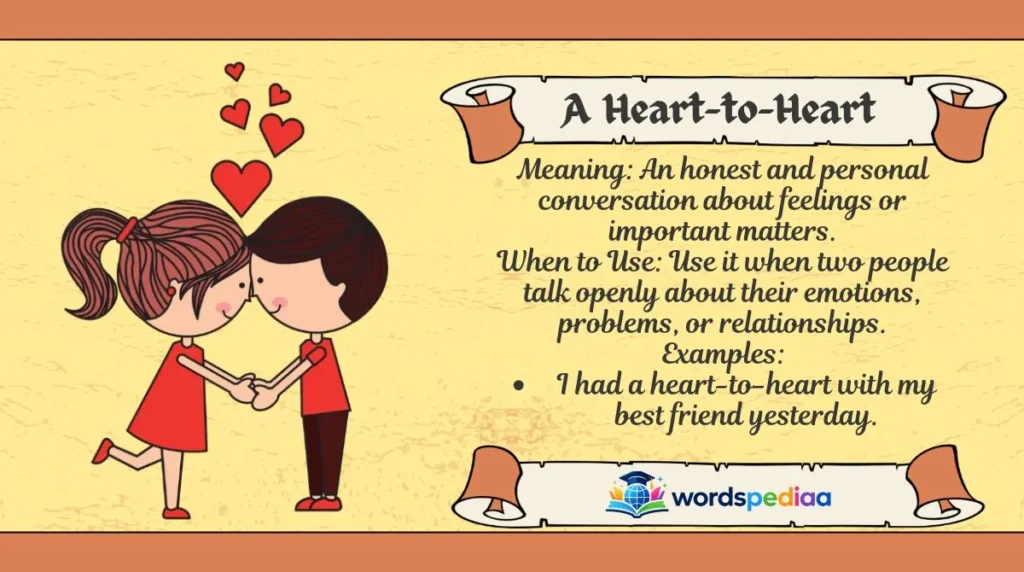
Meaning: An honest and personal conversation about feelings or important matters.
When to Use: Use it when two people talk openly about their emotions, problems, or relationships.
Examples:
- I had a heart-to-heart with my best friend yesterday.
- My father and I had a heart-to-heart about my future.
17. Small Talk
Meaning: Light and casual conversation about everyday subjects.
When to Use: Use this expression for friendly chats about the weather, hobbies, school, or other simple topics. It is common in social situations.
Examples:
- We made small talk while waiting for the bus.
- She enjoys small talk with her classmates during breaks.
18. Make Small Talk
Meaning: To have a casual conversation with someone about simple topics.
When to Use: Use it when starting a friendly conversation with someone you do not know very well.
Examples:
- I made small talk with a new student before class.
- He made small talk with his neighbors at the party.
19. Speak Volumes
Meaning: To show or communicate a lot without needing many words.
When to Use: Use this idiom when someone’s actions, expressions, or behavior reveal their true feelings or character.
Examples:
- Her kind actions speak volumes about her character.
- His silence spoke volumes about how disappointed he felt.
20. Have the Last Word
Meaning: To be the final person to speak in an argument or discussion, often to make a final point.
When to Use: Use it when someone wants to finish a conversation with their own statement or opinion.
Examples:
- My sister always wants to have the last word in an argument.
- The teacher had the last word before ending the discussion.
21. Bite Your Tongue
Meaning: To stop yourself from saying something, especially when you feel angry or annoyed.
When to Use: Use it when you want to avoid making a rude comment or starting an argument.
Examples:
- I wanted to argue with him, but I bit my tongue.
- She bit her tongue instead of making an angry reply.
22. Hold Your Tongue
Meaning: To remain silent instead of saying something.
When to Use: Use this expression when someone should avoid speaking, especially in a tense or serious situation. It can sound like a strong command.
Examples:
- Please hold your tongue until the teacher finishes speaking.
- He held his tongue during the heated discussion.
23. On the Tip of Your Tongue
Meaning: Used when you almost remember a word, name, or piece of information but cannot recall it.
When to Use: Use it when you are trying to remember something but cannot say it immediately.
Examples:
- Her name is on the tip of my tongue, but I cannot remember it.
- I know the answer! It is on the tip of my tongue.
24. Get a Word in Edgewise
Meaning: To find an opportunity to speak when someone else is talking a lot.
When to Use: Use this idiom during group discussions or conversations where one person does not give others a chance to speak. It is informal.
Examples:
- My brother talks so much that I cannot get a word in edgewise.
- Everyone was talking at once, so I could not get a word in edgewise.
25. Word of Mouth
Meaning: Information or recommendations passed from one person to another through conversation.
When to Use: Use it when people learn about a product, service, place, or event through personal recommendations.
Examples:
- I found this restaurant through word of mouth.
- The small business became popular through word of mouth.
26. Talk Behind Someone’s Back
Meaning: To say negative or unkind things about someone when they are not present.
When to Use: Use this expression when describing gossip or secret criticism.
Examples:
- Good friends should not talk behind each other’s backs.
- I felt hurt when I learned that my classmates were talking behind my back.
27. Give Someone a Piece of Your Mind
Meaning: To speak angrily to someone because you are upset about their behavior.
When to Use: Use it when someone strongly expresses their anger or disappointment. It is informal and can sound confrontational.
Examples:
- The customer gave the shopkeeper a piece of his mind after receiving a broken product.
- My father gave me a piece of his mind when I came home late.
28. Talk Shop
Meaning: To discuss work-related topics, often outside normal working hours.
When to Use: Use this idiom when people talk about their jobs, business, or professional interests during a casual conversation.
Examples:
- My parents talked shop during dinner.
- The two teachers started talking shop at the family gathering.
29. Put Words in Someone’s Mouth
Meaning: To suggest that someone said something they did not actually say.
When to Use: Use it when someone misunderstands, changes, or misrepresents another person’s statement.
Examples:
- Please do not put words in my mouth; I never said that.
- He put words in her mouth during the argument.
30. Actions Speak Louder Than Words
Meaning: What people do is more important and convincing than what they say.
When to Use: Use this common saying when you want to explain that actions show someone’s true intentions better than promises.
Examples:
- He promises to help, but actions speak louder than words.
- If you want to prove your friendship, remember that actions speak louder than words.
31. Easier Said Than Done
Meaning: Something sounds simple to do but is actually difficult in real life.
When to Use: Use it when someone gives advice or suggests something that may be hard to put into practice.
Examples:
- Learning a new language takes time. It is easier said than done.
- You say I should stay calm, but that is easier said than done.
How to Use Speaking Idioms Naturally
Learning the meanings of idioms is only the first step. You also need to know when and how to use them. Here are some simple tips to help you speak English more naturally.
1. Learn the Meaning Before Using an Idiom
Never use an idiom just because it sounds interesting. First, understand its real meaning.
For example, break the ice means to make people feel comfortable at the start of a conversation. It does not mean breaking something.
2. Practice With Real Conversations
Try using one or two idioms when speaking with friends, classmates, or family members.
For example:
- “Let me break the ice with a funny story.”
- “Please get straight to the point.”
- “I want to speak my mind.”
Regular practice will help you remember them.
3. Choose the Right Idiom for the Situation
Not every idiom is suitable for every conversation.
For example:
- Informal: Spill the beans!
- Polite: Could you please explain what happened?
- Professional: Let’s get straight to the point.
Some idioms are common in casual speech, while others can also work in professional conversations.
4. Do Not Use Too Many Idioms Together
Using too many idioms in one sentence can make your English sound unnatural.
Instead of using several expressions at once, choose one that fits your message.
For example:
“I want to get straight to the point.”
This sounds clearer than putting several unrelated idioms into the same sentence.
5. Listen to English Speakers
Watch English videos, interviews, and conversations. Pay attention to how people use idioms and what situations they use them in.
You can also repeat short sentences to improve your speaking skills.
6. Avoid Common Mistakes
Here are some mistakes English learners should avoid:
- Changing the words: Learn the correct form of each idiom.
- Taking idioms literally: Understand their figurative meanings.
- Using informal expressions in formal situations: Some idioms may sound too casual in professional writing.
- Ignoring context: An idiom should match the meaning and tone of the conversation.
- Forcing idioms into every sentence: Clear English is better than unnatural English.
Practice Exercise: Test Your Knowledge of Speaking Idioms
Choose the correct idiom to complete each sentence. Try answering all five questions before checking the answer key.
1. I told a funny joke to ______ at the party.
- A. Break the ice
- B. Spill the beans
- C. Hold your tongue
2. Please stop ______ and tell me what happened.
- A. Speaking volumes
- B. Beating around the bush
- C. Walking the walk
3. My friend convinced me to join the competition. She ______.
- A. Talked me into it
- B. Bit her tongue
- C. Had the last word
4. I almost remember his name. It is ______.
- A. Word of mouth
- B. On the tip of my tongue
- C. Small talk
5. He makes many promises, but his actions are different. Remember, ______.
- A. Actions speak louder than words
- B. Let the cat out of the bag
- C. Have a word with someone
Answer Key
- A — Break the ice
- B — Beating around the bush
- A — Talked me into it
- B — On the tip of my tongue
- A — Actions speak louder than words
Frequently Asked Questions
1. What Are the Most Common Idioms Used in Speaking?
Some common speaking idioms include break the ice, speak your mind, get straight to the point, small talk, spill the beans, and beat around the bush. People use these expressions in everyday conversations, social situations, and discussions.
2. How Can Idioms Improve English Speaking Skills?
Idioms help you express thoughts and feelings in a more natural way. They also help you understand everyday English conversations, movies, interviews, and discussions. Learning them can improve your vocabulary and speaking confidence.
3. Should English Beginners Learn Idioms?
Yes! Beginners can learn simple and common idioms. Start with expressions such as break the ice, small talk, and speak your mind. Learn their meanings and practice using them in short sentences.
4. Can I Use Idioms in Formal Conversations?
Some idioms are suitable for professional conversations, but others are too informal. For example, get straight to the point can work in a business meeting, while spill the beans is more suitable for casual conversations. Always consider your audience and situation.
5. How Many Idioms Should I Learn Every Day?
Start with two or three idioms each day. Learn their meanings, write example sentences, and practice saying them aloud. It is better to understand and use a few idioms correctly than to memorize many without knowing how they work.
Conclusion
Learning idioms is a useful way to improve your English speaking skills. These 31 idioms for speaking can help you start conversations, share opinions, express feelings, and understand other people more easily.
Start with a few expressions, practice them in real-life situations, and slowly add more to your vocabulary. Remember, good speaking is not about using difficult words. It is about sharing your ideas clearly and confidently.

Oliver Hayes is a passionate technology writer and digital marketing enthusiast with expertise in SEO, WordPress, blogging, and web development. He creates practical, well-researched content that helps readers learn new skills and stay updated with the latest trends in the digital world.