

Mothers hold a big place in our lives, and in our words too. English has many warm, funny, and sharp phrases about them. We use idioms about mothers to talk about love, care, strict rules, and a mother’s fierce wish to keep her child safe.
Some are sweet praise, like a mama bear. Some are light jokes. A few can sting if you use them the wrong way. This guide gives you 22 useful idioms about mothers, with clear meanings, simple examples, and honest tips on tone, so you can use each one well.
Quick Answer?
Some of the best idioms about mothers are a mother hen, one who fusses over others, a mama bear, a mother who fights to protect her child, and mother knows best, a saying that a mother’s advice is wise.
What Are Mothers Idioms?
Mothers idioms are fixed phrases that use the word mother or describe mothers. Their meaning is not always clear from each word alone. A mama bear is not a real bear. She is a mother who protects her child fiercely. These idioms about mothers can sound warm, strict, funny, or rude.
Quick Overview?
This table lists all 22 idioms about mothers, with short meanings and best contexts.
| # | Idiom | Short Meaning | Best Context |
|---|---|---|---|
| 1 | A mother hen | Fusses over others, keeps them safe | Family, teachers |
| 2 | A mama bear | Fierce mother who protects her child | Modern talk, parents |
| 3 | Mother Nature | Nature seen as a mother figure | Weather, seasons |
| 4 | An earth mother | Warm, natural, caring mother type | Gentle praise |
| 5 | A tiger mother | Very strict mother, high demands | Modern talk, studies |
| 6 | A stage mother | Pushy mother of a young performer | Shows, contests |
| 7 | A soccer mom | Busy mother, drives kids to sport | US talk, family |
| 8 | A mama’s boy | Man too close to his mother | Teasing, can offend |
| 9 | A yummy mummy | Stylish, fit young mother | British slang |
| 10 | Mother knows best | A mother’s advice is wise | Family advice |
| 11 | Necessity is the mother of invention | Need makes people create new things | Work, problems |
| 12 | A face only a mother could love | A plain face, said as a joke | Friends, humour |
| 13 | At your mother’s knee | Learned as a small child | Skills, values |
| 14 | Mother’s milk | A basic need, or learned very early | Habits, work |
| 15 | The mother of all | The biggest or worst of its kind | Modern talk, news |
| 16 | Mother tongue | The first language you learn | School, travel |
| 17 | The motherland | Your home country | Speeches, poems |
| 18 | Shall I be mother? | I will pour the tea | British meals |
| 19 | Mother’s ruin | Gin, in old British slang | Old slang, pubs |
| 20 | The mother lode | A rich source of good things | Finds, luck |
| 21 | Every mother’s son | Every single person | Old-fashioned talk |
| 22 | Mother Goose | Imagined teller of nursery rhymes | Children’s rhymes |
22 Useful Idioms About Mothers
1. A mother hen
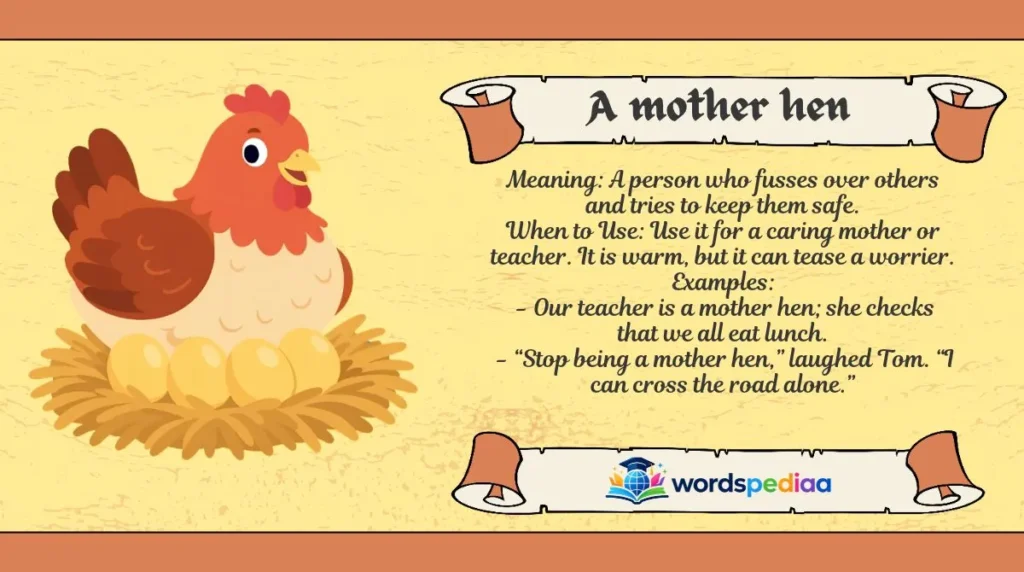
Meaning: A person who fusses over others and tries to keep them safe.
When to Use: Use it for a caring mother or teacher. It is warm, but it can tease a worrier.
Examples:
– Our teacher is a mother hen; she checks that we all eat lunch.
– “Stop being a mother hen,” laughed Tom. “I can cross the road alone.”
2. A mama bear
Meaning: A mother who becomes fierce when her child is in danger. This is a modern phrase.
When to Use: Use it in proud talk about a mother who defends her child.
Examples:
– When the boys mocked her son, a real mama bear came out in her.
– She is calm most days, but a mama bear if you hurt her kids.
3. Mother Nature
Meaning: Nature seen as a mother figure who controls weather and seasons.
When to Use: Use it for rain, storms, and the power of the wild world.
Examples:
– Mother Nature sent heavy snow on the first day of spring.
– You cannot fight Mother Nature; the river will rise when it rains.
4. An earth mother
Meaning: A warm, natural woman who loves home and nature and cares for people with ease.
When to Use: Use it as gentle praise for a caring, down-to-earth mother or friend.
Examples:
– Rosa is an earth mother; her home is full of plants, soup, and kids.
– The camp leader, an earth mother, calmed every scared child.
5. A tiger mother
Meaning: A very strict mother who demands top marks and hard work. A modern term.
When to Use: Use it for strict study rules. It can be praise or a complaint.
Examples:
– A tiger mother set two hours of piano practice each day.
– He thanks his tiger mother now; her rules got him into a top school.
6. A stage mother
Meaning: A mother who pushes her child hard to win fame in shows or contests.
When to Use: Use it about show business and contests. It is a criticism, not praise.
Examples:
– The singer’s stage mother spoke to the judges more than he did.
– She is no stage mother; her girl may quit the show.
7. A soccer mom
Meaning: A busy mother who drives her kids to sports and school events. A modern US term.
When to Use: Use it in US talk about family life. It can be a joke about a busy routine.
Examples:
– As a soccer mom, she keeps juice boxes and spare shoes in the car.
– The soccer moms met at the field each Saturday with hot coffee.
8. A mama’s boy
Meaning: A boy or man who is too close to his mother. British English says mummy’s boy.
When to Use: Use it only as a light tease with close friends. About an adult man, it can offend.
Examples:
– His mates call him a mama’s boy because he phones his mum each night.
– Do not call him a mummy’s boy at work; it is not kind.
9. A yummy mummy
Meaning: A young mother who looks stylish and fit. Modern British slang.
When to Use: Use it only in fun talk among friends. It can sound rude.
Examples:
– The magazine called the actress a yummy mummy weeks after her baby was born.
– She laughed at the yummy mummy label and wore her old jeans anyway.
10. Mother knows best
Meaning: A saying that a mother’s advice is wise.
When to Use: Use it when a mother’s old advice turns out to be right, often with a smile.
Examples:
– I took an umbrella, as Mum said. Mother knows best — it poured all day.
– “Eat well, sleep early.” Mother knows best, as exam week showed.
11. Necessity is the mother of invention
Meaning: A proverb: when people truly need something, they find new ways to make it.
When to Use: Use it when a problem forces a smart new idea or tool.
Examples:
– With no ladder, he built one from old wood. Necessity is the mother of invention.
– Farms with little water grew new crops; necessity is the mother of invention.
12. A face only a mother could love
Meaning: A humorous way to say a face is plain, but a mother still loves it.
When to Use: Use it as a joke about yourself or a pet. It can hurt a stranger.
Examples:
– Our old dog has a face only a mother could love, and we adore him.
– He grinned at his photo and said, “A face only a mother could love!”
13. At your mother’s knee
Meaning: Learned as a small child, in the phrase learn something at your mother’s knee.
When to Use: Use it for skills or values learned very early in life.
Examples:
– She learned those songs at her mother’s knee and still sings them.
– He learned to be kind to guests at his mother’s knee.
14. Mother’s milk

Meaning: Something that feels like a basic need, or a thing learned and loved very early.
When to Use: Use it about habits, skills, or strong likes, not about real feeding.
Examples:
– Music is mother’s milk to him; he plays before school each day.
– Debate was mother’s milk for the young lawyer; she grew up on it.
15. The mother of all
Meaning: The biggest or worst example of something, in the pattern the mother of all + noun. It is a modern pattern.
When to Use: Use it for fun stress on size or force. Keep it out of formal reports.
Examples:
– Last night we had the mother of all storms.
– We sat in the mother of all traffic jams for two hours.
16. Mother tongue
Meaning: The first language a person learns as a child at home.
When to Use: Use it in school and language talk. Here “mother” means source, not a real mother.
Examples:
– Her mother tongue is Urdu, but she teaches in English.
– Jokes are easier in your mother tongue than in a new language.
17. The motherland
Meaning: The country where you were born or your family comes from. Also called mother country.
When to Use: Use it in speeches and poems. It can sound political, so use it with care.
Examples:
– After years abroad, he came back to serve the motherland.
– The poem calls the motherland’s green hills a mother’s arms.
18. Shall I be mother?
Meaning: A British phrase meaning “Shall I pour the tea?” The one who pours acts as host.
When to Use: Use it at a British tea table, as a warm, fun offer.
Examples:
– “Shall I be mother?” asked Aunt May, and she poured tea for us all.
– At the picnic, Ben held the pot and said, “Shall I be mother?”
19. Mother’s ruin
Meaning: Gin, in old British slang.
When to Use: You may meet it in old books or songs. People rarely use it now.
Examples:
– In the old song, the sailors drank mother’s ruin all night.
– The pub sign showed “mother’s ruin” on a bottle, as a joke.
20. The mother lode
Meaning: A rich main source of something good, first used for a main vein of gold.
When to Use: Use it when someone finds a large supply of good things.
Examples:
– In the attic we hit the mother lode: four boxes of old photos.
– That old bookshop was the mother lode for rare maps and prints.
21. Every mother’s son
Meaning: Every single person, with no one left out. An old-fashioned phrase.
When to Use: Use it to stress that a rule covers all people. It fits stories best.
Examples:
– Every mother’s son in the village came to the fair that year.
– The new tax hit every mother’s son, rich and poor alike.
22. Mother Goose
Meaning: The imagined old woman said to tell famous nursery rhymes for children.
When to Use: Use it for children’s rhymes and storybooks. It is a culture note, not a real mother.
Examples:
– The baby’s first book was full of Mother Goose rhymes.
– She read a Mother Goose poem each night before the children slept.
How to Use These Idioms Naturally
Tone comes first with idioms about mothers. A word about someone’s mother can warm a heart or start a fight. Safe, warm choices are a mother hen, Mother Nature, and mother knows best. They fit family talk and rarely offend.
Some are jokes. A mama’s boy (or mummy’s boy) and a yummy mummy are teasing labels. They sound funny with close friends, but rude about a coworker. A face only a mother could love is a joke about looks, so keep it for yourself or a pet. Do not use a stage mother or a tiger mother to a mother’s face; both are criticisms.
Watch word senses. In mother tongue and the mother lode, “mother” means first source, not a woman. In mum’s the word and keep mum, “mum” means silence, not mother — a common trap. Save old slang like mother’s ruin for books, not daily talk.
Practice Exercise
Fill each gap with the best idiom about mothers.
- When a dog ran at her little girl, Sarah turned into a real ________ and scared it off.
- Sara is a kind of ________ in our flat; she feeds us and checks we sleep well.
- “Hot tea for everyone? ________?” said Grandma, holding the pot.
- When the shop had no bags left, the owner sewed cloth ones. ________, as they say.
- His first language is Arabic; it is his ________.
Answer Key
- mama bear — she became fierce to protect her child.
- mother hen — she fusses over the group with care.
- Shall I be mother — she offers to pour the tea.
- Necessity is the mother of invention — a need brought a new idea.
- mother tongue — the first language learned at home.
Frequently Asked Questions
What is the most common idiom about mothers?
Mother knows best and Mother Nature are very common. People use the first for wise advice, and the second for weather and seasons.
Which idioms about mothers can offend?
A mama’s boy and a stage mother can offend, because they judge a real person. A yummy mummy can also sound cheap. Use such labels only with close friends.
What does “the mother of all” mean?
It is a pattern for the biggest or worst of a kind, as in “the mother of all storms.” It fits news talk, not formal reports.
Is “mum’s the word” about mothers?
No. In mum’s the word and keep mum, “mum” means silence or a secret. It has nothing to do with mothers.
How can I learn idioms about mothers fast?
Learn two or three at a time and note the tone: warm, strict, or joking. Use one the same day.
Conclusion
Idioms about mothers make the English language more beautiful, meaningful, and expressive. They help us describe a mother’s love, care, kindness, wisdom, sacrifices, and special role in our lives.
Expressions like “a mother’s love,” “like mother, like daughter,” “mother knows best,” and “the apple doesn’t fall far from the tree” add warmth and meaning to everyday conversations. Learning these idioms can improve your English vocabulary, speaking, and writing skills.
They are useful in daily conversations, family discussions, storytelling, and creative writing. By understanding and using mother-related idioms correctly, you can express feelings about motherhood more naturally and appreciate the special bond between mothers and their children.

Oliver Hayes is a passionate technology writer and digital marketing enthusiast with expertise in SEO, WordPress, blogging, and web development. He creates practical, well-researched content that helps readers learn new skills and stay updated with the latest trends in the digital world.