

Age is a number we carry through life, and English has a phrase for almost every stage of it. A child reaches school age. A teen may pass through the awkward age. Adults talk about being in your twenties, middle-aged, or of working age.
Good idioms about age help you name these stages in daily talk, news, and books. Some are legal phrases, like of age and under age. Some are warm or funny.
This guide gives you 23 idioms about age, with clear meanings, simple examples, and usage tips, so you can speak about each stage with ease.
Quick Answer?
Some of the best idioms about age are come of age, which means to reach adult age, in your twenties, the decade from 20 to 29, and a golden age, a past time when something was at its best. Each one names a stage of life.
What Are Age Idioms?
Age idioms are fixed phrases that name a point or stage of life. Under age does not just mean young. It means too young by law. These idioms about age can be legal, plain, or playful. The right one depends on the stage you mean and who you talk to.
Quick Overview?
This table lists all 23 idioms about age, with short meanings and best contexts.
| # | Idiom | Short Meaning | Best Context |
|---|---|---|---|
| 1 | Come of age | Reach legal adult age | Law, birthdays |
| 2 | Of age | Old enough by law | Law, forms |
| 3 | Under age | Too young by law | Rules, shops, clubs |
| 4 | A certain age | Middle or older age | Polite talk |
| 5 | In your teens | Aged 13 to 19 | School years |
| 6 | In your twenties | Aged 20 to 29 | Study, first jobs |
| 7 | Middle-aged | Between young and old | News, daily talk |
| 8 | The age of consent | Legal age to agree | Law, news |
| 9 | An age limit | Set age for an activity | Contests, jobs, rides |
| 10 | An age gap | Difference in age | Couples, siblings |
| 11 | Age-old | Very old, long known | Problems, customs |
| 12 | For ages | For a very long time | Casual talk |
| 13 | In this day and age | In modern times | Speech, opinions |
| 14 | The Stone Age | Very old or out of date | Jokes, old things |
| 15 | A golden age | A best era | History, art, sport |
| 16 | The awkward age | Shy, clumsy teen years | Children, teens |
| 17 | Mental age | Age level of the mind | Tests, school reports |
| 18 | The age of reason | Age when a child can reason | Books, child growth |
| 19 | Old enough to know better | Should act wisely by now | Mild blame |
| 20 | School age | Old enough for school | Children, families |
| 21 | Working age | Years when people work | News, reports |
| 22 | Retirement age | Age to stop work | Pensions, news |
| 23 | A coming-of-age story | Story of growing up | Books, films |
23 Useful Idioms About Age
1. Come of age
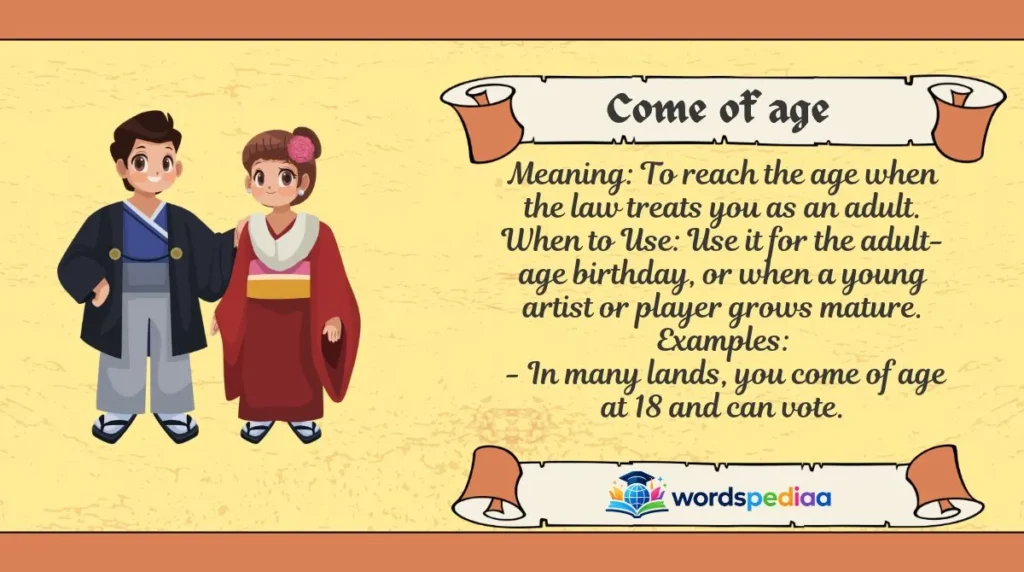
Meaning: To reach the age when the law treats you as an adult.
When to Use: Use it for the adult-age birthday, or when a young artist or player grows mature.
Examples:
– In many lands, you come of age at 18 and can vote.
– As a singer, she truly came of age with her calm, mature third album.
2. Of age
Meaning: Old enough by law to do a thing, such as vote or sign a form.
When to Use: Use it in legal or formal talk. The common form is “be of age.”
Examples:
– You must be of age to sign this form alone.
– Now of age, Tom can apply for a full driving licence.
3. Under age
Meaning: Too young by law for a thing, like buying alcohol.
When to Use: Use it in rules, signs, and news. It is often written as one word, “underage.”
Examples:
– The shop was fined for selling strong drinks to under age teens.
– He is under age, so the club cannot let him in.
4. A certain age
Meaning: A polite, vague way to say middle or older age, with no exact number.
When to Use: Use it when you do not wish to state a person’s real age. It sounds gentle and playful.
Examples:
– A woman of a certain age may not wish to share her birth year.
– Men of a certain age often take up calm hobbies like gardening.
5. In your teens
Meaning: In the years from 13 to 19; the teenage years.
When to Use: Use it for school years, first jobs, or young habits.
Examples:
– She learned to swim in her teens at the local pool.
– Many people keep the friends they made in their teens for life.
6. In your twenties
Meaning: In the decade of life from age 20 to 29.
When to Use: Use it for study, first jobs, and travel years. Add “early” or “late” to be exact.
Examples:
– He spent his early twenties at college and his late twenties abroad.
– In your twenties, small savings can grow into a safe future.
7. Middle-aged
Meaning: In the stage of life between young and old, roughly age 40 to 60.
When to Use: Use it as a plain stage label in news and daily talk. It is neutral, not rude.
Examples:
– The middle-aged teacher still plays football with her sons weekly.
– A middle-aged man in a grey coat asked us for the train times.
8. The age of consent
Meaning: The lowest age at which the law allows a person to agree to sexual activity.
When to Use: Use it only in law, news, and study. The age is set by law and differs by land.
Examples:
– After long debate, the state raised the age of consent by law.
– The report said the court first checked the age of consent there.
9. An age limit
Meaning: A set youngest or oldest age for an activity, job, or contest.
When to Use: Use it for races, rides, sports, and job ads with a clear age rule.
Examples:
– This race has an age limit of 16, so young children cannot enter.
– There is no age limit for the art class; all ages are welcome.
10. An age gap

Meaning: A difference in age between two people. “Age difference” means the same.
When to Use: Use it for couples, friends, siblings, or teams. It is neutral.
Examples:
– The age gap between the brothers is ten years.
– An age gap of five years means little in a friendship.
11. Age-old
Meaning: Very old; known for a very long time.
When to Use: Use it before words like problem, question, or custom. Write it with a hyphen before a noun.
Examples:
– It is an age-old problem: too much work and too little time.
– The age-old custom of sharing bread still opens every feast here.
12. For ages
Meaning: For a very long time.
When to Use: Use it in casual talk about waiting or not seeing a friend.
Examples:
– We waited for ages at the bus stop.
– I have known Sara for ages; we met at primary school.
13. In this day and age
Meaning: In the present time; in modern life now.
When to Use: Use it to compare life today with the past, often in speech or opinion pieces.
Examples:
– In this day and age, most people pay their bills by phone.
– In this day and age, a letter by post feels slow.
14. The Stone Age
Meaning: The earliest time of human tools; as a joke, anything very old or out of date.
When to Use: Use the joke form for old tools or habits. Keep it light and friendly.
Examples:
– His phone is from the Stone Age; it cannot take a photo.
– The office still keeps paper files, like the Stone Age.
15. A golden age
Meaning: A past time when a thing was at its best and most successful.
When to Use: Use it for an era in art, sport, or film — not for one person’s life.
Examples:
– Many call the 1950s a golden age of cinema.
– Fans still see that decade as the golden age of rock music.
16. The awkward age
Meaning: The early teen years, when a child can feel clumsy, shy, and unsure.
When to Use: Use it for the stage around age 11 to 14, always with kindness.
Examples:
– At the awkward age, many children grow shy about school photos.
– She felt clumsy and unsure at the awkward age of thirteen.
17. Mental age
Meaning: The age level that matches a person’s mind skills, shown by tests.
When to Use: Use it in school and health reports, with care and respect.
Examples:
– Doctors may test mental age to plan school support for a child.
– A mental age score helps teachers choose tasks that fit a child.
18. The age of reason
Meaning: The age, around seven, when a child starts to think and judge clearly.
When to Use: Use it in books about child growth. It is an old, formal phrase.
Examples:
– By the age of reason, a child can tell right from wrong.
– Old books say children reach the age of reason at about seven.
19. Old enough to know better
Meaning: Old enough to act with sense, so a foolish act deserves mild blame.
When to Use: Use it as a gentle telling-off for someone who acts without thought.
Examples:
– He is 30 and old enough to know better than to shout at staff.
– You are old enough to know better; say sorry to your sister.
20. School age
Meaning: Old enough to start school, usually around age five or six.
When to Use: Use it for young children and family services. Before a noun, write “school-age.”
Examples:
– When the twins reach school age, the house will grow quiet by day.
– The centre runs a low-cost club for school-age children after class.
21. Working age
Meaning: The years when people usually hold a job, roughly age 16 to 65.
When to Use: Use it in news and reports about jobs, taxes, and population.
Examples:
– The town has many people of working age but few local jobs.
– As more people pass working age, care homes need more trained staff.
22. Retirement age
Meaning: The age at which a person can stop work and receive a pension.
When to Use: Use it in news and money talk. The exact age differs by land and job.
Examples:
– The state plans to raise the retirement age over the next ten years.
– She reached retirement age last spring and left her job with a smile.
23. A coming-of-age story
Meaning: A book or film about a young person growing into an adult.
When to Use: Use it for novels and films about teen life and growth.
Examples:
– Her novel is a coming-of-age story set in a small town.
– The film is a warm coming-of-age story about two close school friends.
How to Use These Idioms Naturally
Start by matching the phrase to its job. The legal phrases — of age, under age, an age limit, and the age of consent — appear in laws, signs, and news. Keep them exact. The stage labels — in your teens, in your twenties, and middle-aged — are plain and safe in daily talk.
Do not mix up a golden age and the golden years. A golden age is the best era of a thing, like film or music. The golden years are the later years of one person’s life. They sound alike but name different ideas.
Watch the small forms. Say in your twenties, not “in your twenty.” Use a hyphen before a noun: a school-age child, a middle-aged man, an age-old problem. Laws differ by land, so never quote one age of consent as if it fits the whole world.
Be polite about real ages. Asking an adult their exact age can feel rude. Soft phrases like a certain age let you speak about age with respect.
Practice Exercise
Fill each gap with the best idiom about age.
- In most lands, you ________ at 18 and gain full adult rights.
- The club turned him away because he was ________.
- We have not met ________; it must be nearly ten years.
- Many fans call the 1970s a ________ for disco music.
- This bike looks like it came straight from ________!
Answer Key
- come of age — you reach legal adult age.
- under age — he was too young by law.
- for ages — a very long time.
- golden age — the best era for disco.
- the Stone Age — a joke for a very old thing.
Frequently Asked Questions
What is the most common idiom about age?
Come of age and in this day and age are very common. Use come of age for reaching adult age or growing mature, and in this day and age for modern times.
What is the difference between a golden age and the golden years?
A golden age is the best era of a thing, like music or film. The golden years are the later years of one person’s life, often after work ends. One names a time in history; the other, a stage of life.
What does “a certain age” mean?
It is a polite way to speak of middle or older age with no number. People say “a woman of a certain age” when the exact age is private. It sounds gentle and a little playful.
Is it rude to ask someone their age?
In many places, yes. It can feel rude to ask an adult directly, though children and close friends are usually fine. If you must speak about age, a certain age is safer and softer.
How can I learn idioms about age fast?
Learn two or three at a time and use them the same day. Link each phrase to a real stage: school age for a child you know, working age for yourself. Real links make recall easy.
Conclusion
Every stage of life has its own words. Now you know 23 idioms about age, from come of age to a coming-of-age story. Pick the phrase that fits the stage, keep legal phrases exact, and use these idioms about age in daily talks. With practice, they will soon feel natural.

Oliver Hayes is a passionate technology writer and digital marketing enthusiast with expertise in SEO, WordPress, blogging, and web development. He creates practical, well-researched content that helps readers learn new skills and stay updated with the latest trends in the digital world.