

We drive, ride, and travel every day, and English borrows much of its talk from the road. Good idioms about driving help you speak about control, speed, plans, and mistakes in a clear, natural way. A boss can be a backseat driver.
A hard year can be a bumpy ride. Some of these idioms are about trips, but most are used beyond cars, at work, at school, and at home. This guide gives you 23 idioms about driving, with clear meanings, simple examples, and usage tips, so you can use each one with care.
Quick Answer?
Some of the best idioms about driving are in the driver’s seat, which means to be in control, step on the gas, which means to hurry or speed up work, and a dead end, a plan or path that can go no further.
What Are Driving Idioms?
Driving idioms are fixed phrases that come from cars, roads, and travel. Their meaning is not always clear from each word alone. If you are in the driver’s seat, no car is needed. You are the one in control. These idioms about driving can sound firm, funny, or full of energy.
Quick Overview?
This table lists all 23 idioms about driving, with short meanings and best contexts.
| # | Idiom | Short Meaning | Best Context |
|---|---|---|---|
| 1 | In the driver’s seat | In control of a plan | Work, teams |
| 2 | Take the wheel | Take control or lead | Work, projects |
| 3 | A backseat driver | One who gives unwanted advice | Bossy people, cars |
| 4 | Drive someone up the wall | Make someone very annoyed | Noise, habits, kids |
| 5 | Along for the ride | Present but not in charge | Trips, group plans |
| 6 | On the road | Travelling from place to place | Trips, tours, work |
| 7 | The end of the road | The point where it must stop | Jobs, talks, plans |
| 8 | Down the road | At a later time, in future | Plans, life talk |
| 9 | Middle of the road | Moderate, not extreme | Views, music, taste |
| 10 | Put the brakes on | Slow down or stop something | Spending, plans, work |
| 11 | Step on the gas | Hurry up, work faster | Deadlines, races |
| 12 | Full speed ahead | Go forward with full energy | Projects, plans |
| 13 | In the fast lane | A busy, exciting life | City life, careers |
| 14 | Shift gears | Change pace or approach | Work, study, sport |
| 15 | Do a U-turn | Change a plan completely | News, decisions |
| 16 | Take a wrong turn | Make a bad choice | Life, work, trips |
| 17 | At a crossroads | Must choose between paths | Life, careers |
| 18 | A dead end | No way forward | Jobs, talks, plans |
| 19 | Steer clear of | Avoid on purpose | Trouble, people, topics |
| 20 | What someone is driving at | The real point they mean | Talks, hints, meetings |
| 21 | Asleep at the wheel | Not paying attention in charge | Work, safety, duty |
| 22 | A near miss | A close call, just avoided | Travel, work, sport |
| 23 | A bumpy ride | A rough time ahead | Trips, projects, life |
23 Useful Idioms About Driving
1. In the driver’s seat
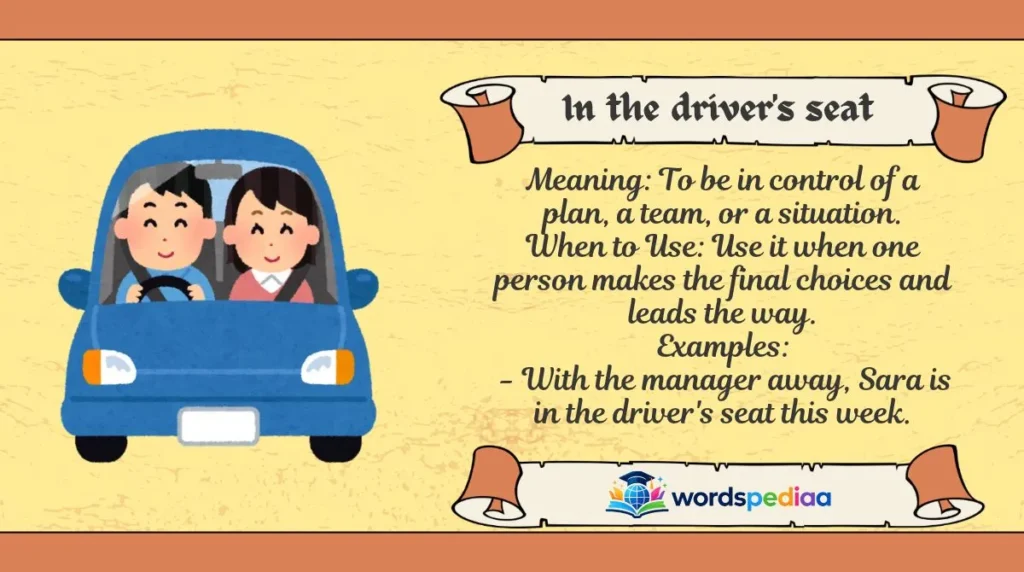
Meaning: To be in control of a plan, a team, or a situation.
When to Use: Use it when one person makes the final choices and leads the way.
Examples:
– With the manager away, Sara is in the driver’s seat this week.
– After the loan, he felt in the driver’s seat of his own life.
2. Take the wheel
Meaning: To take control and lead a task or a group.
When to Use: Use it when a new person starts to lead, or when you offer to lead.
Examples:
– Our lead is sick, so Ben will take the wheel on this job.
– You look tired. Let me take the wheel for the last hour.
3. A backseat driver
Meaning: A person who keeps giving advice that no one asked for.
When to Use: Use it for a bossy passenger, or for anyone who criticises from the side.
Examples:
– My uncle is a real backseat driver; he comments on every turn.
– Do not be a backseat driver. Let the cook work in peace.
4. Drive someone up the wall
Meaning: To annoy someone a lot with noise, habits, or repeated acts.
When to Use: Use it in casual talk when a small thing keeps testing your patience.
Examples:
– That dripping tap drives me up the wall all night long.
– His loud music drove the neighbours up the wall every evening.
5. Along for the ride
Meaning: To join a trip or plan without leading it or doing much work.
When to Use: Use it when someone is present for fun but has no real role.
Examples:
– I know little about farms; I just came along for the ride.
– She joined the team late and went along for the ride to the final.
6. On the road
Meaning: Travelling, or away on a trip for work or shows.
When to Use: Use it for tours, sales trips, and long drives away from home.
Examples:
– The band is on the road for six weeks this spring.
– After two flat tyres, we are back on the road at last.
7. The end of the road
Meaning: The point where a plan, job, or talk cannot go on.
When to Use: Use it when something must stop for good, often with a sad tone.
Examples:
– After ten years, the small shop reached the end of the road.
– If talks fail this week, it is the end of the road for the deal.
8. Down the road
Meaning: At a later time; in the future, near or far.
When to Use: Use it when you talk about results or choices that come later.
Examples:
– A few years down the road, this course will help your career.
– Save now, and life will be easier down the road.
9. Middle of the road
Meaning: Not extreme; safe and moderate in view, taste, or style.
When to Use: Use it for mild views or plain music that most people can accept.
Examples:
– His views are middle of the road, so both sides can work with him.
– The show plays middle of the road songs that suit all ages.
10. Put the brakes on
Meaning: To slow down or stop an activity, plan, or habit.
When to Use: Use it for spending or a plan that grows too fast. People also hit the brakes for a sudden stop.
Examples:
– High prices forced us to put the brakes on home repairs.
– The city put the brakes on new towers near the old town.
11. Step on the gas

Meaning: To hurry up or work faster to finish in time.
When to Use: Use it when time is short and a team must speed up its work, not its car.
Examples:
– The deadline is Friday, so we must step on the gas now.
– Losing by two goals, the team stepped on the gas late on.
12. Full speed ahead
Meaning: To move forward with full energy and no delay.
When to Use: Use it when a plan is approved and the team can start at once.
Examples:
– The grant came through, so it is full speed ahead for the lab.
– With permits in hand, the builders went full speed ahead.
13. In the fast lane
Meaning: Living a busy, exciting life with risk, money, or fame.
When to Use: Use it for fast city careers or wild social lives, as in life in the fast lane.
Examples:
– As a stock trader, he lives life in the fast lane.
– She left the fast lane and moved to a quiet village.
14. Shift gears
Meaning: To change your pace, focus, or way of doing something.
When to Use: Use it when a plan needs a new approach. To be in top gear is to work at your best speed.
Examples:
– After the break, the class shifted gears to exam practice.
– Once the orders rose, the small shop shifted gears and hired help.
15. Do a U-turn
Meaning: To change a plan, rule, or view by a full turn.
When to Use: Use it for leaders or firms that drop a plan and choose the opposite.
Examples:
– The mayor did a U-turn and kept the park open.
– The firm did a U-turn on prices after buyers complained.
16. Take a wrong turn
Meaning: To make a choice that leads to a bad result.
When to Use: Use it for a real wrong road, or for a career or life mistake.
Examples:
– We took a wrong turn and reached a farm, not the town.
– He feels he took a wrong turn when he quit his course.
17. At a crossroads
Meaning: At a point where you must choose one path or another.
When to Use: Use it for big life choices, like a job, a move, or study.
Examples:
– At thirty, Maya is at a crossroads in her career.
– The talks are at a crossroads; one more step can save them.
18. A dead end
Meaning: A path, job, or talk with no way forward or no future.
When to Use: Use it for streets with no exit, stuck talks, or jobs with no growth.
Examples:
– This lane is a dead end, so turn the car around.
– He left the dead end job and trained as a nurse.
19. Steer clear of
Meaning: To avoid a person, place, or topic on purpose.
When to Use: Use it when you warn someone to keep away from trouble or risk.
Examples:
– Steer clear of that road after dark; it floods fast.
– She steers clear of office gossip and keeps to her work.
20. What someone is driving at
Meaning: The real point a person means but has not said plainly.
When to Use: Use it as a question when a hint or long talk hides the main point.
Examples:
– Just tell me plainly: what are you driving at?
– I see what she is driving at; she wants a longer break.
21. Asleep at the wheel
Meaning: Failing to pay attention while you are in charge of something.
When to Use: Use it for leaders or staff who miss clear signs of trouble.
Examples:
– The guards were asleep at the wheel when the gate alarm failed.
– If sales fall for months, managers cannot stay asleep at the wheel.
22. A near miss
Meaning: An event that almost went wrong but ended safely.
When to Use: Use it for close calls on roads, at work, or in sport.
Examples:
– Two buses had a near miss at the wet crossing this morning.
– The falling ladder was a near miss for the painter below.
23. A bumpy ride
Meaning: A period with many problems and changes, not a smooth one.
When to Use: Use it to warn that a trip, plan, or year ahead will be rough.
Examples:
– Hold on; the new firm faces a bumpy ride this year.
– The bus trip through the hills was a bumpy ride for us all.
How to Use These Idioms Naturally
Most idioms about driving are not about real cars. In the driver’s seat, a dead end, and at a crossroads talk about control, stuck plans, and choices. Use them at work, in class, and in daily talk.
Match the tone. A backseat driver and asleep at the wheel are sharp criticisms; say them about a pattern, not as a quick insult. Drive someone up the wall is casual and strong, fine for friends, not formal letters. Middle of the road can be mild praise or mild blame, so make your point clear.
Watch mistakes. Down the road means later in time, not a place. Say steer clear of, not “steer clear from”. Put the brakes on needs an object: the brakes on spending or on a plan.
One safety note: these idioms play with speed, but real roads are not a game. Follow speed limits and drive with care; keep step on the gas for work and deadlines.
Practice Exercise
Fill each gap with the best idiom about driving.
- With the boss on leave, Tom is ________ this week and makes all the calls.
- My brother comments on every turn I make. He is such a ________.
- The two sides stopped talking, so the talks hit ________.
- This new project will face many problems; expect a ________.
- Please ________ of that topic at dinner; it always starts a fight.
Answer Key
- in the driver’s seat — he is in control this week.
- backseat driver — he gives unwanted advice.
- a dead end — the talks can go no further.
- bumpy ride — the time ahead will be rough.
- steer clear — avoid that topic on purpose.
Frequently Asked Questions
What is the most common idiom about driving?
In the driver’s seat and a dead end are very common. The first means control of a plan or team; the second means a path or job with no future.
What does “life in the fast lane” mean?
It means a busy, exciting life, often with money, risk, or fame. It sounds fun, but it can hint at stress.
What is the difference between put the brakes on and step on the gas?
They are opposites. Put the brakes on means slow down or stop an activity. Step on the gas means hurry up and work faster.
Can I use these idioms about driving in formal writing?
A few, like down the road and at a crossroads, appear in news and reports. Most are casual, so in formal letters use plain words. Idioms fit speech best.
How can I learn idioms about driving fast?
Learn two or three at a time and use them the same day. Short daily use builds memory fast.
Conclusion
Roads give English lively speech. Now you know 23 idioms about driving, from the firm in the driver’s seat to the rough bumpy ride. Pick the one that fits, watch your tone, and use them in daily talks.

Oliver Hayes is a passionate technology writer and digital marketing enthusiast with expertise in SEO, WordPress, blogging, and web development. He creates practical, well-researched content that helps readers learn new skills and stay updated with the latest trends in the digital world.